Showing posts with label satyajit. Show all posts

December 13, 2018

The Indian Express Celebrates Ray's 97th Birthday


    Source:indianexpress.com
Written by Shivangi Jalan |New Delhi |Published: May 2, 2018 2:42:57 pm

Interesting facts about the legendary filmmaker: Satyajit Ray on his 97th Birthday. 


Legendary filmmaker Satyajit Ray would have celebrated his 97th birthday today. The filmmaker not only played a major role in placing India on the global cinematic map but his works continue to inspire a number of acclaimed filmmakers even today. No wonder, acclaimed filmmakers like Christopher Nolan call Ray’s first film Pather Panchali one of the best films in the history of filmmaking. On his 97th birth anniversary, here’s looking at some interesting facts about Satyajit Ray’s life.

Fact No. 1. Satyajit Ray belonged to a family of writers. In his early life, Ray was a huge fan of Oriental art. His frequent visits to Ajanta, Ellora and Elephanta caves stimulated his love for Indian art. He had started his career as an illustrator working for different companies.
Fact No. 2. He was even assigned the job to design the cover for the children’s version of Pather Panchali, renamed as Aam Antir Bhepu. While illustrating the book, Ray got hugely influenced by the story and even made it the subject of his feature debut. Shots of his illustrations also featured in the film.
Fact No. 3. Only after getting introduced to French director Jean Renoir did Ray get especially interested in filmmaking. During his three-month stint in London, Satyajit Ray watched a staggering total of 99 films but among them, Ladri di biciclette (Bicycle Thieves) by Vittorio De Sica had the most profound impact on him. It is said that he walked out of the theatre determined to be a filmmaker.
Fact No. 4. Satyajit Ray’s first film Pather Panchali was shot for three years. Also, the film’s cast and crew were all rookies, making the shooting even more difficult.
Fact No. 5. Ray even struggled with the film’s funding for a long time as he was determined on not changing any part of the story or perspective to the whims of a producer. The budget was so shoe-string that Ray had to sell a lot of his personal belongings to complete the film. Only after taking a loan from the Bengal government, Ray was able to release the film in 1955. It went on to receive great critical and commercial success, not just in India but also globally.
Fact No. 6. For Aparajito, the second film of the Apu trilogy, much of the story is drawn from Satyajit Ray’s own experiences. For instance, Apu going to Calcutta and finding lodging with a printer echoes the young Satyajit Ray living above his grandfather’s printing press. 
Fact No. 7. Ray was also able to launch two industry stalwarts with his final Apu film, Apur Sansar. While Soumitra Chatterjee who played the grown-up Apu collaborated with Ray in almost every film he directed, Apu’s bride Aparna was played by the 14-year-old Sharmila Tagore.
Fact No. 8. After the famous Apu Trilogy, Satyajit Ray experimented with genres. He also went on to make films on the British Raj period, various documentaries including one on Rabindranath Tagore and even comedies like Mahapurush. His major films in this period include Charulata, Devi and Sandesh.
Fact No. 9. This might come as a shock to many but Ray had accused Steven Spielberg of borrowing the basic idea from his unrealised sci-fi film The Alien for his E.T. The Extra-Terrestrial. He went on record and said, “At least two of the Spielberg-Lucas films, Close Encounters of the Third Kind and ET, would not have been possible without my script of The Alien being available throughout America in mimeographed copies. Some days back Arthur Clark telephoned me from London, saying that I should file a copyright case and should not take it lying down.”
Fact No. 10. Satyajit Ray even delved into the genres of fantasy, science fiction, detective dramas and historical dramas in his later years. The Academy of Motion Picture Arts and Sciences awarded him an Honorary Academy Award in 1992. On April 23 in the same year, Ray breathed his last but his brilliant legacy sure lives on.


June 20, 2011

Album #10


June 18, 2011

Ramsundar Deo to Satyajit Ray – A Brief History of Ray Family


Source -  Andrew Robinson's the inner eye


Part -1

The story begins with Ramsundar Deo, the earliest-known ancestor of Ray family, a Hindu by religion, a youth by age, moved from a village in West Bengal to East Bengal (now Bangladesh), wondering there, he reached a village called ‘Serpur’ where at the local zamindar’s house he met the ruler of a nearby place called ‘Yasodal’. He likes Ramsundar for his quick intelligence and invited him to Yasodal. There Ramsundar was given a piece of land, a house and a daughter in marriage. Ramsundar spent his life administrating the property of his in law’s.

Subsequently, the generations of his family live there in Yasodal, and later moved further deep into the east, a place called ‘Masua’. It was located on the other side of the Brahmaputra river. The family across time gathered wealth and education and also acquired the title of ‘Majundar’, a common Bengali surname which means ‘revenue accountant’. The actual surname which the family uses today was another honorific title ‘Ray’. The word was derived from another Bengali word ‘Raja’ (means king).  Then in the latter half of the eighteen century the family was further divided into two branches. The reason was a flood that destroyed the Masua. As a result the family, one of which became noted for its learning, the other for its wealth and piety got separated in course of time and situation.

Among the two families, one was lead by Ramkanta Majundar. A man of talent, he was very fluent in several languages, an expert singer and musician. Not only that, he was a man of great physical strength and courage. It is said that he would eat a full basket of parched rice and a whole jackfruit for breakfast. In another incident it is said that once Ramkanta was sitting in his verandah, when a wild boar attacked him. He grabbed its snout and held it in his vice-like grip before shouting for help.     

It was this particular generation that developed the verse in the family, as Ramkanta’s eldest son has this habit of replying to a question in verse. Ramkanta had three sons. Among them the youngest one became a famous scholar in Persian. But the second son, Loknath, was so fluent in Sanskrit, Arabic & Persian that he was able to read aloud in one language from a book written in another so fluently that his listeners would not know that he was actually translating.  But unfortunately, Loknath started taking interest in Tantric yoga in his twenties, which on the other hand was a matter of concern for his father, who thought that his son may go into sannyasi. As a result Ramkanta secretly gathered his books and other sacred objects one day and dropped them in to the river. Loknath was so shattered that he took to a fast and died within three days. As he lay on his death bed he told his weeping wife, who held their only child, ‘Now you have only, but from him will come a hundred!’ -  A famous family story often repeated in Satyajit Ray’s childhood a century later.

Loknath’s son was Kalinath, father of Upendrakisore, great grandfather of Satyajit Ray, was probably born in 1830s. He too was a scholar in Sanskrit, Arabic and Persian, but not a sannyasi. Kalinath Ray was better known as ‘Munshi (Professor) Syamsundar’ in his time, which was quite an unusual distinction for a Hindu in a period when Islam was in retreat all over the India.

India at that time was under the British rule, and Brahmos were the most energetic group of Bengalis who evolved and reacted strongly both to Christianity, western literature and ideas such as sati in that particular period of time (around 1820s). Founded & lead by Raja Rammohan Roy, the greatest Indian intellectual of nineteenth century.  Later after his death, Devendranath Tagore, father of Rabindranath Tagore led the Brahmos. The Ray family became associated with the Brahmos in 1880s.


Part-2

Upendrakisore, Sukumar Ray’s father & Satyajit’s grandfather was born in 1869. Although he was born in ‘Masua’, a rural area in Bangladesh, but soon made a long journey to Calcutta, where he too got attracted towards Brahmoism. Upendrakisore was the fifth son of Kalinath Ray. And he was been adopted at the age of five by a childless relative belonging to the orthodox, wealthy branch of Ray family. This relative, a zamindar and lawyer by profession chose Upendrakisore among his brothers due to his skin color, which was indeed really very fair. Not only that, the relative who adopted him also changed his name to Upendrakisore from Kamadaranjan, after the style of his own name, Harikisore, to which he added the honorific surname of ‘Ray Chaudhuri’.

From a very young age Upendrakisore, was quite fond of music and drawing. One when the Governor visited his school he saw a boy was drawing intensely in the class. With curiosity, he picked up the book to discover an amazing drawing/sketch. The Governor was a British man, and in reference to that the school teachers were quite worried as to how the ‘sahib’ would react. But, instead, the ‘sahib’ patted little Upendrakisore, and said – ‘You must not let this skill disappear’. 

Upendrakisore stayed in Calcutta, and kept his practice of drawing and singing. He later stated practicing the Indian classical style under the best teachers and also developed his love for Brahmo songs and hymns.  His singing was so good that once at a performance at Jorasanko, the Tagore family mansion in North Calcutta, led him to the lifelong friendship with Rabindranath Tagore.

In the year 1884, Upendrakisore got married to the daughter of Dwarkanath Ganguli, and moved to the large family house at 13 Cornwallis Street in central Calcutta, just opposite to the main temple of the Brahmo. Upendrakisore’s wife was a remarkable woman in her own right. She bore him three sons and three daughters. Among them, Sukumar, Satyajit’s father, was their second child, born in 1887. On the other hand, Upendrakisore continued his practice of drawing and music. He often used to play his Violin and sing. He was so good in it, that often listeners gathered in the street outside, just like as they did when he took his family outside to an exhibition or festival and explained things to the children. 

Sukumar Ray took after his father in many ways. He was serious, lively and intensely curious and also a natural story teller. From a very young age, he would show pictures of wired and wonderful animals to his brothers and sisters from their father’s storybook, and invent his own story about them.  He also used to create his own creatures, with untranslatable names. When Sukumar was about eight, a new element appeared in his life, which later also influenced Satyajit Ray greatly. It was the printing press. 

Calcutta by 1890s was well equipped with printing press technologies, but good quality printing & its illustration was seriously lacking. As a result of this, Upendrakisore’s illustrations of Ramayana for children’s book were totally ruined. With merely a handful of technical books published in West, Upendrakisore decided to start first Calcutta based high quality printing process. Soon his effort brought him international prizes for best quality printing reproduction. Soon he started to order cameras and various pieces of half tone equipments from British. The money for such investment came from selling most of his share in the zamindari to his foster brother Narendrakisore, who was in charge of it, following his father, Harikisore’s death. 


Part-3


The printing firm of U.Ray was founded in 1895. And the experimentations began instantly.  On the other side, Rabindranath was an enthusiastic advocate of Upendrakisore’s writings, and encouraged him a lot to translate and adopt stories from abroad, and from the Bengal as well as from the Indian legends. It is said that Tagore was a regular visitor at Upendrakisore’s house, and in that course of time Sukumar became one of Tagore’s favorite young friends. 

Sukumar Ray, father of Satyajit Ray, was a bright student from his very early age. At school both teachers and his class mates were highly influenced of him. They all liked him very much, especially because of his independent spirit without being rebellious. In 1906, Sukumar Ray left Presidency College, with double honours in Physics and Chemistry.  The famous ‘Non sense club’ also began around this time. ‘Sare Batris Bhaja’ (thirty two and a half delicacies) – was the name of the first play that Sukumar wrote for this club.  The play was about the street cry of the Calcutta hawkers who used to sell those thirty two varieties of savoury and a half chilli. Among the other plays, ‘Jhalapala’, ‘Laksmaner Saktisel’ and Ramayana were some of them.  

Sukumar Ray was also a good photographer, his first piece, ‘Photography as an art’ was based on considerable practical experience. He took many photographs in his early teen age, developed and printed them all by himself. Very few people know that Sukumar Ray was the second Indian who got the Fellowship of the Royal Photographic Society in 1922.

Upendrakisore never went abroad, but he made sure that his son dose so. As a result Sukumar Ray took up a scholarship in 1950 and went to London to study printing and photography techniques. Later Satyajit Ray in 1950 also went at the same, for graphics design.  While his stay at London, Sukumar inhabited two distinctive worlds of specialized crafts. One was the photo-engraving and Lithography and the other was his social and artistic life. 

Other parts coming soon...
May 29, 2011

Dulal Dutta

Source: TOI


For 36 long years that Satyajit Ray made films, Dulal Dutta had been his constant companion. From Pather Panchali to Agantuk, Dutta edited all his films. After Ray's death, Dutta worked in Uttaran and Target that were directed by the master filmmaker's son, Sandip.

The 86-year-old passed away on Tuesday night following prolonged illness. "The Tollygunge film industry has lost a good technician," said film editor Shuvro Ray.

"The rhythm of editing, cut-point were something I learnt from his work. From the editor's perspective, two films that immediately come to my mind are Jana Aranya and Ashani Sanket. Especially, Jana Aranya. The jump-cut impressed me a lot. The editing is still so contemporary. There was a lot to learn from him. I had the opportunity to interact with him once when I was working on a film as an editor. I have tried to follow him at times," he added.

It's said that much of the credit for the famous Apu-Durga sequence in Pather Panchali where the siblings sprint across a field towards a running train in the backdrop of swaying kaash stalks should actually go to Dutta. Ray had shot a lesser number of frames than was required for the sequence and Dutta came to his rescue.

"He edited the frames brilliantly to create an illusion of motion. It turned out to be one of the high points of the film and has come to symbolize Indian cinema ever since," said film expert Sanjoy Mukhopadhyay. He edited Pather Panchali' working round the clock for two weeks to get the film ready for its premiere in

New York.

Cinematographer Soumendu Ray who was himself associated with about a dozen Ray films recalled Dutta as a quiet, humble man who was deeply immersed in his work. "I have known him since the Pather Panchali' days. Later, we worked together in several Ray films. He was an honest professional and could be ruthless to ensure that the film retained its pace. While editing Ashani Sanket', he insisted on chopping off a couple of scenes which I wanted retained. Eventually, he prevailed upon Manikda (Ray) to allow him to do it. Even though it left me disheartened, I realized that he was right. He knew his job," said Ray.

Apart from the Ray films, Dutta also worked with other directors like Tarun Mazumdar and others. He was quintessentially a Ray man. Dutta considered Aparajito his best work in the Ray oeuvre. His story didn't begin with Ray, but it did end with him.

It was in 1942 when Dutta ran off to Mumbai. The first few nights were spent below the ticket counter at Dadar railway station. As fate would have it, he met a make-up man called K L Maitra, who was then working in a Noor-Jehan and Shyam starrer, Nadaan. Dutta started off as a make-up assistant, at times doubling up as a clap-boy. But his interest was in the editing lab and he would often hang around the place. Finally, he was allowed inside.

Some years later, he returned to Kolkata and started working as an editing assistant. While working for a film called Barjatri where the art director was Bansi Chandragupta, Dutta got the offer to work in Pather Panchali. That was in 1951. The rest, as is said, is history.

Experts like Mukhopadhyay believe Dutta's brilliance lay in maintaining the film's narrative and making sure that the sequences went by in a smooth flow.

"He could get under the director's skin and know exactly what was expected of him. Dutta rarely tried anything different, but there was never a jarring note in the films edited by him. We have lost a master technician," said Mukhopadhyay.

May 12, 2011

Goopi Bagha Phirey Elo - Full Length Classic Bengali Movie - Tapen Chatterjee & Robi Ghosh


For more details regarding the above movie, click here
Video Source : RajshriBengali

Pather Panchali (Full Movie)


For more details regarding the above movie, click here
Video Source : RajshriBengali

Hirok Rajar Deshe (Full Movie, With ST)


For more details regarding the above movie, click here
Video Source : RajshriBengali

May 11, 2011

Satyajit Ray films still the most popular in Bengal


Source: TOI
KOLKATA: Nineteen years after Satyajit Ray breathed his last in 1992 at the age of 70, cine buffs in the city continue to mourn the passing away of the legendary director. Though contemporary Bengali cinema has come of age in recent years with interesting scripts and competent direction, movie-goers continue to miss Ray's midas tough.
On the sidelines of a function organized by Ekhon Satyajit—a publication dedicated on Ray's films and film-making techniques—to commemorarte Ray's 90th birth anniversary, magazine editor Somnath Roy felt Ray would be a near impossible task to beat. Ray was as popular in India as abroad with his movies winning accolades at all major film festivals including Cannes. He was conferred an honorary Academy Award for lifetime achievement in cinema a month before he died.
"What sets Ray apart from other film-makers like Ritwik Ghatak and Mrinal Sen is the simplicity of narrative form, consistency of subject choice and great cinematography. His frames were so powerful that they get etched in memory. Today's movies are technically a lot improved. Some of the alternate films have good scripts. Others have sparkling cinematography. But overall, the harmony that one gets to sense in a Ray movie is missing," said Roy.
During his career as a film-maker spanning 1955-1991, Ray made 26 feature films, 5 documentaries and 2 short films. Each of them is heralded as a classic and remain as popular today with audiences never failing to attend Ray retrospectives. Among them were the Apu trilogy (Pather Panchali, Aparajito and Apur Sansar ), Devi, Kanchenjungha, Mahanagar, Charulata, Nayak, Goopy Gyne Bagha Byne, Aranyer Din Ratri, Seemabaddha, Asani Sanket, Sonar Kella, Jana Aranya, Shatranj Ke Khilari, Ghare Baire and Agantuk.
Ace photographer Nimai Ghosh, whom Ray had called 'a Boswell working with a camera rather than a pen' and had captured the master in action from 1967 till his death in 1992, is still in awe of the film-maker. "I was in a trance all those years and did it purely out of my admiration for Ray. I was star-struck and in awe of him till the last. I would click him relentlessly and often I would be unhappy with the frames. But I would keep taking his photos for I couldn't stop myself," recalled Ghosh.
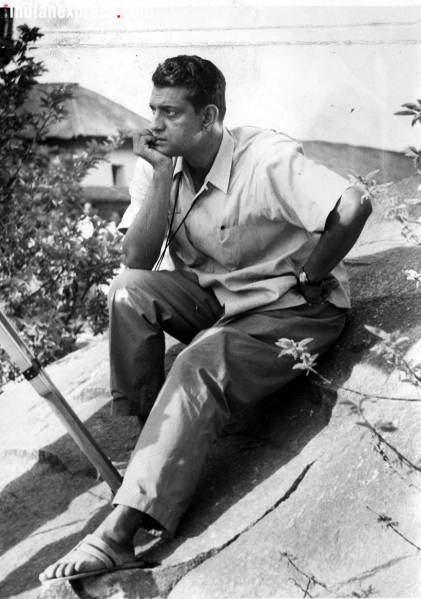
He took more than 80,000 photographs of Ray, which almost graphically depict his life and work. Like the one in which Ray is perched on a rock during an outdoor shoot and another which shows the master in an animated discussion with his actors at a script-reading session. Such is the popularity of Ray that Ghosh's book of black & white photographs on the maestro that was released a couple of days ago, has been a sell-out.

March 24, 2011

Album #8

Cover-design for Pramada Ranjan Ray's "BON'er KHOBOR"(news frm the Forest) by Ray.

Ray's costume-design for d character of 'Sobha-Kobi'(Court poet) fr HIRAK RAJAR DESHE.

Costume designs for the ministers in the court of HIROK RAJA..
Designed by Ray.

Ray with Kishore Kumar and Amit Kumar. Kishore Kumar's first wife, Mrs Ruma Guha Thakurtha was Ray's niece. Kishore shared a warm relationship with Ray and used to call him 'Manik Mama'. He sang in Ray's "CHARULATA" for the first time..a Tagore song(Ami chini go chini). Then Kishore's voice was again heard in Ray's GHARE BAIRE in 1984. This time he sang three songs..two of Tagore's and the other of Jyotirindranath's.

This picture shows Ray..wid his 6ft 4" height..removing the idol of Lord Ganesha from the entrance of the house in Lucknow..to make the house appear as a Muslim residence..for SHATRANJ KE KHILADI..(1977)

Ray's cover-design for Jibananada Das's "BONOLATA SEN".

Cover design for SANDESH..by Ray. The above issue was the 25th anniversary special number..published in May 1986

Unused title-card for JOY BABA FELUNATH. Jst c d artistic excellence..at a glance..it seems to be written in Hindi..bt the actual thing is dat Ray used the Devanagari script to write the titles in Bengali.

Cover-design by Ray for Abanindranath Tagore's autobiography in Bengali "Apon Kotha"..published by Signet Press

Ray's cover-design for Jibananada Das's "RUPOSI BANGLA".

Cover design for SANDESH..by Ray. For this issue..Ray also drew comics for the first time..!!
The colourful world of Ray..fascinates us even today..
Let us spread this colourful works through this group..
HAPPY HOLI..!!

The title-card of KANCHENJUNGA..designed by Ray.

Ray, arriving at the busy Howrah station to shoot the train-arrival scene for his swansong "Agantuk".

A page from the shooting-script of "Sonar Kella"...the jottings explain the camel-scene of the Three Musketeers(Felu, Lalmohan n Topshe)..!!

Costume designs by Ray for HIROK RAJAR DESHE.

The two men who created the Song of the Little Road.

Another advertisement..designed by Ray..when he worked as a graphic-designer at D.J.Keymer, a British ad-agency..during pre-Pather Panchali period.

The notation sheet of "DEKHO RE NOYON MELE.." from GUGABABA.

Notation sheet by Ray fr "Bhuter Raja Dilo Bor" frm GUGABABA.

Shooting schedule for AGANTUK..designed by Ray.

Notation sheet by Ray fr "Moharaja Tomare Selam" frm GUGABABA
Feluda is havin a make-over in d hands of d director!!

Ray..in d role of an idol-maker..fr JOY BABA FELUNATH.

Ray..explaining a scene from "Laksham'er Shaktishel" to Soumitra Chatterjee during the shooting of "SUKUMAR RAY"(1987). Chatterjee enacted the role of Lord Rama in the play..while actor Chiranjeet played Lakshman.

One of the few ad-designs by Ray when he worked at D.J.Keymer during pre-Pather Panchali period.

The first big-screen appearance of Bengal's most famous super-sleuth!!
Poster designed by Ray.

The first publicity poster of GUGABA..designed by Ray..published in d April 1968 issue of SANDESH.